
Canadian Sunset

AIR QUALITY UNHEALTHY. PLEASE REMAIN INDOORS.
Clifton put his good glasses on to read the text, then took them off and dragged a chair onto the porch.
“This is how men die.”
Rosetta followed because she no longer trusted him to make good decisions in an emergency.
“Sitting on their porch?”
“Not listening.”
“I listened. Then I paid it no never mind.”
Rosetta waved him off, then looked at the sunset.
It was beautiful in the way that fire might be beautiful when your family wasn’t losing everything.
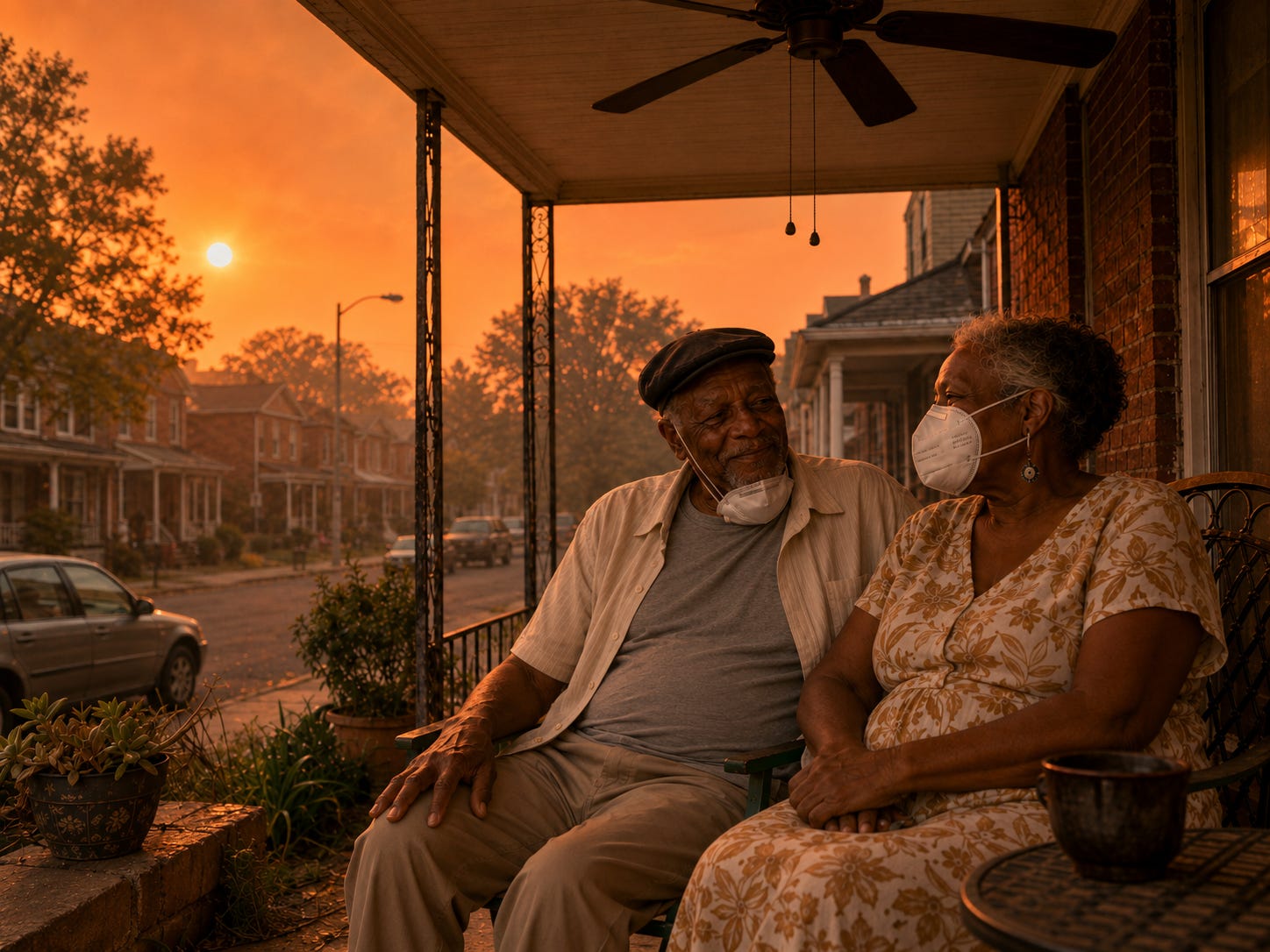
At 8:16, the sun hung low over West Avery as if it were trying to apologize for failing that day. It was red and puffy, like an eye that had been rubbed all day. Smoke moved through Freeman Avenue like a rumor, turning everything the color of an old picture stuck to the page in an album.
Clifton and Rosetta Pierce sat on their porch in the heat beneath a ceiling fan that hadn’t been of use since 2018. Clifton promised he would fix it the next day. Rosetta hadn’t mentioned it since the first time they felt it was safe to return to the porch after COVID-19 killed three of their neighbors, her two sisters, and his uncle.
“You see that sun?”
Clifton couldn’t take his eyes off the sky.
“My eyes still work.”
“Ain’t never seen’t a sun that red.”
“Yeah, you have.”
“When?”
“Yesterday.”
“It ain’t look like that yesterday.”
“Looked exactly like that.”
Rosetta leaned back in her seat, wiped at the sweat pooling around her nose, and laughed to herself. Clifton leaned forward to get a better look at the sky, like it held answers to questions he didn’t yet have.
The man on the news said the smoke came from Canadian wildfires. The city’s Facebook page advised everyone to stay inside, keep their windows closed, avoid strenuous activities, and run an air purifier if they had one.
Clifton and Rosetta didn’t own an air purifier.
They owned three fans, a space heater, a humidifier Rosetta picked up at an estate sale, and a dehumidifier Clifton kept for when the basement flooded after heavy rain. But no air purifier. Still, Rosetta put the humidifier near the living room window and gave it a chance to do something it wasn’t made to do.
“Think we should go inside?”
Clifton never took his eyes from the sun.
“We never should’ve been out here.”
“But you came.”
“I came with you.”
Clifton settled back in his seat.
The N95 mask he wore was beneath his chin. Rosetta wore hers properly over her nose and mouth, showing the eyes she used to judge her husband of forty-two years. Nobody sat on the Johnsons’ porch across the street. The wind chimes on the Crowleys’ porch, two houses down, sang lazily because the air seemed too heavy to travel. A car started further down the block.
“You remember how sunsets look down The Bottoms?”
Clifton was reminiscing.
“You didn’t live in The Bottoms.”
Rosetta adjusted her mask because her glasses were fogging.
“My grandmother lived there.”
“For one summer, you only visited twice because they ran you out of there for stealing somebody’s bicycle.”
“I did not steal that bike.”
“You rode that boy’s bicycle all the way to SouthCut.”
Clifton pulled his mask over his mouth, maybe because his chest was getting heavy from the smoke, maybe because he wanted to end the conversation.
“Can’t even see the country club.”
Clifton pointed.
From their porch, they could usually see Raymond Greene’s mansion, which was the highest point in North Hill, and then trace a line of trees to Sable Run. This evening, the entire hill disappeared beneath the cloud of smoke.
“Maybe God finally got tired of looking at it.”
Rosetta never forgave Sable Run for its existence.
The golf course flooded after a heavy rain; sinkholes opened occasionally, and Rosetta counted it all as joy. Tonight, the Canadian smoke erased the entire place, and it felt like providence.
It had been over thirty years since the city tore down what was left of The Bottoms and allowed the land to be used by rich people who needed a place to hit a little white ball, not a place to live. Rosetta’s aunt had lived there with three of her cousins, one of whom died in the massive flood of '92. The city moved them to Griffin Row with enough money to pay two months’ rent and a speech about progress.
“RESIDENTS ARE ADVISED TO REMAIN INSIDE.”
An SUV with Avery Heights emblazoned on its doors rolled slowly down Freeman Ave., a speaker mounted on the roof cutting through the smoke.
Clifton nodded his head.
The driver did not acknowledge him.
“RESIDENTS SHOULD AVOID PROLONGED EXPOSURE TO THE PARTICLES.”
The SUV stopped at the corner, and the window rolled down slightly. A small cloud emerged from the window before it closed.
“That came from Avery Heights.”
Rosetta laughed behind her mask.
“CHECK ON YOUR ELDERLY NEIGHBORS.”
“Don’t you even think about it.”
Clifton looked at Rosetta, who had a mischievous gleam in her eyes.
“I didn’t say anything.”
“You thought it.”
“I’m seven months younger than you.”
The city vehicle turned left and restarted its script on Lionel Street.
A fly landed on Clifton’s left hand. He swatted at it and missed. Leaving a red mark on his hand.
“Nobody told the flies the air wasn’t safe.”
He seemed more concerned than annoyed.
“They’re just out to get something sweet.”
Rosetta never looked but knew Clifton smiled.
The sky darkened into a copper-like hue. Clifton and Rosetta heard the faint sound of a child’s cough, then a mother’s voice, followed by a screen door crashing closed.
“We should probably take it on in.”
Clifton’s smile faded slowly.
Rosetta agreed but didn’t move.
Neither did Clifton.
They had spent most evenings on this porch since Clifton retired from Avery Heights Water and Sewage in 2012. Before that, Rosetta sat alone until his car slowed to a stop in front of the house. Before that, the porch was a bike rack, home base, doctor’s office, and stage to call their children home when the streetlights came on. Before that, there were two chairs and a radio, because they were saving up to buy a table.
That porch had watched their children grow and have children of their own.
Was there when their parents died.
It lived through West Avery’s redevelopment plans, revitalization plans, public safety plans, a councilman’s plans to rename the neighborhood The Freeman Arts District, even though there were no artists and no district.
This porch did not trust plans.
Rosetta didn’t either.
“You ever get scared?”
Clifton pulled his mask down.
“Of the smoke?”
“No. All this.”
He spread his arms out.
That space held the smoke, the red sun, the disappeared golf course, the emergency alerts, and all the things they’ve stopped talking about.
Rosetta thought for a moment.
“I’m tired of the things that reach this porch that ain’t supposed to.”
Clifton nodded his agreement.
Everything reached you now.
A fire thousands of miles away reached your lungs. A war across the world found its way into your gas tank. A storm in the Midwest raised your grocery bill. A decision downtown changed entire neighborhoods before anyone on your block knew there was a meeting.
Seemed like it was nothing but bad news these days.
Clifton reached across and took Rosetta’s hand.
She stared at her hand in his.
“You trying to get romantic because we in the last days?”
“I hold your hand all the time.”
Her look asked when.
“At church.”
“You talking about prayer?”
“At the doctor.”
“That’s when I’m scared.”
“At the movies.”
He thought he had her there.
“That’s because you fall asleep and need me to make sure you’re still breathing.”
He squeezed her hand.
She smiled.
The sun began to disappear behind the rooftops.
For a moment, the sun bled through the smoke, and everything turned gold — the grass, the sidewalks, the leaves on the trees, Clifton’s hand wrapped around Rosetta’s.
It was the closest the neighborhood looked to normal all week.
Rosetta was a bit irritated but still smiled.
“Would you look at that?”
“I see it.”
“God is something else.”
Clifton nodded.
“On a day like today, he still made a little space for beauty.”
“Twice.”
Clifton took the chance to make her smile.
Then coughed.
“That’s it. We’re going in.”
“I’m fine.”
“You coughed.”
“I swallowed wrong.”
“You've been swallowing for seventy-eight years. Now you forget how?”
She stood and pulled his hand up along with her. The two of them walked slowly toward the door; they didn’t glance back at the sunset. Clifton stopped once they got inside.
“They say it’s gonna be better tomorrow. What you think?”
“Maybe. Maybe not. But we won’t be the same fools.”
She nudged him further into the house and closed the door before he could argue with her.
The porch was finally alone.
The ceiling fan hung above empty chairs.
The smoke rolled into the night.
And somewhere in Canada, trees that had never heard of Avery Heights continued to burn.