
The Ancestors' Walk

By eight fifteen, Sable Run Golf & Country Club had already transformed Juneteenth into something unrecognizable. The grass was manicured perfectly. The golf carts were waxed. The windows at the clubhouse were so spotless that everyone who smiled at their reflection could almost see clearly into the past, to what had sat on this land before it became this sprawling golf course.
The Bottoms.
That’s what people used to call it. It’s not that the land was worthless or that the families there were lower than the rest of the city. It was called The Bottoms because rainwater pooled there; because the Sable River constantly blew its breath through the neighborhood, and it smelled like mud, moss, and last week’s bacon.
Before the fairways and men whispering about the stock market and someone’s wife, The Bottoms had men sitting on porches arguing about whether Sugar Ray Leonard was a better fighter than Sugar Ray Robinson, and women who snapped peas, with a box fan in the window behind them.
The city said it was flood-prone. The word from North Hill was that it was blighted. But those families called it home. Six days of historic rain in April 1993 became an opportunity. Opportunity was one of those words that developers used when people were about to lose something.
A sinkhole swallowed one home, and the neighboring house peeked into the hole like it was checking on a friend. By the third day, the fire department had to borrow boats from the state to rescue six families from the rising floodwater.
George Byrd, Avery Heights mayor at the time, announced at an emergency council meeting that The Bottoms was a disaster area and the remaining families needed to be evacuated for their safety. His exact words. It wasn’t lost on anyone that he, and every mayor before him, ignored the drainage problems, the cracks in the foundation of most of the homes, every church lady who walked into City Hall after a hard rain to complain about the water coming through their floorboards.
Some families were moved into Griffin Row or SouthCut. The majority were moved into West Avery, shoved into crowded apartments in Palmetto Terrace or Jewel Gardens, or vacant homes with more to fix to love. A few left Avery Heights altogether. Harold Jefferson packed what he could into his Oldsmobile and drove his wife, daughter, and two grandsons to Alabama, leaving his son to figure it out for himself. James Younger loaded his wife, their Bibles, church clothes, and his toolbox, and headed to West Virginia, saying he would start over where his father became a man.
The thirty-seven remaining homes were razed over the next two months. By September, there were whispers of the golf course. Folks in Old Avery said Byrd brokered a deal over two glasses of cognac and a briefcase at his feet. He resigned the next summer to a beachfront property in Ft Lauderdale, built by the same company that handled the construction and design of Sable Run.
The power center in North Hill called it a coincidence; the rest of the city called it what it was.
The West Avery Consortium was invited to the Juneteenth Legacy Breakfast, which was not the same as being welcomed. They wore yellow T-shirts with their logo emblazoned in the center, and the words “Freedom ain’t Free,” over dresses, linen pants, or shorts. They talked in language sharpened by nonprofit training and grant applications. They called people “stakeholders” instead of neighbors. They said “community activation” when they really meant that people might show up if there were food and music.
“Our presence is needed in these rooms”
Ameerah Bell, the Consortium’s founder, stood next to fruit, trying her best to look relaxed.
Kahlil Cole nodded, even though he knew the room had been explicit about who belonged and who was tolerated.
At the entrance, Mayor Miles Holloway looked like he was already over the day’s activities. His father, Walter Holloway, was the city’s founder in the hearts and minds of those who’d been there since the beginning. Their last name was plastered on a park, two streets, an arts center, two municipal buildings, a senior center, a law firm, scholarships, and the tip of the tongues of a quarter of the residents of Avery Heights.
Walter Holloway may have founded Avery Heights, but Isaiah Avery claimed it first.
Isaiah had been enslaved, then freed, then walked north until he reached land folks said was too damp, too unforgiving. Haunted by river fog and bad soil, but Isaiah settled on the land anyway and built where people said it was impossible. Before incorporation and a city charter, a free Black man stood on that land, deciding to live.
Miles Holloway flashed his practiced smile at the microphone, the same smile he put on his face after Byrd flew South, and he became the interim mayor. He hasn’t moved from that seat since.
“Juneteenth is a reminder that freedom can not only be announced, but that it must be claimed, protected, and passed on, until everyone can hold onto it.”
People clapped. Not politely, but because it felt like he really meant it.
Malik “Link” Doggett stood in the back, watching the applause get louder. Link was never invited to these types of events, but always found his way in. He was a man comfortable in Avery Heights’ shadows, but the city moved and stopped when his finger waved.
“They put them flags in the holes like they discovered something here. A whole neighborhood gone.”
Link stared out the window at the fairway and said it loud enough for one of the young servers near him to hear. The young man laughed and kept moving. Link looked around the room, waiting for the joke to be ended by a brick through a window or fire on the lawn.
Right before noon, the Juneteenth parade made its way through City Center, late, loud, but beautiful. Children chased each other around the vendor tables that sold waist beads, cannabis infused lemonade, and T-shirts with Harriet Tubman on the cover of a mixtape. The high school band played “Before I Let Go” as the dance team led, twerking a new definition of freedom.
A 1965 convertible Ford Thunderbird, carrying a waving Mayor Holloway, made its way through the park bearing his last night to a waiting drummer’s circle.
The park was full of elders in tents, children eating water ice, the smoke from the grills and smokers lined against the edge of the grass, and the joy of a city that appeared whole from a distance.
If you looked closely enough, you could see the slightest of rips at the seams.
SouthCut once knew the meaning of Juneteenth. The old neighborhood held a block party, with somebody’s grandmother explaining the true meaning of the day after a group of kids sang “Lift Every Voice and Sing”. But those memories had been priced out, replaced by murals of Black women who could no longer afford the rent in the zip code.
The Marigold Room had a Freedom Brunch, complete with crab omelet, champagne toast, and people saying, “Happy Juneteenth”, like they were introduced to the phrase that morning in an Instagram post. The hostess, missing one of her hoop earrings, handed out menus with tiny raised fists next to the day’s specials: strawberry margaritas, mini chicken and & waffles, and braised turkey wings. Near the bar, a young woman asked if Juneteenth was something like the Black Fourth of July, and her friend said, “Exactly”, as they toasted their glasses.
Outside, the banner flying above Ashby Street flowed with the wind:
HAPPY JUNETEENTH FROM THE SOUTHCUT BUSINESS GUILD
Most folks passed under without ever looking up.
That was the new SouthCut, filled with Black art and Black dollars, but short on Black memory. Beautiful in the way that life is after the living has ended.
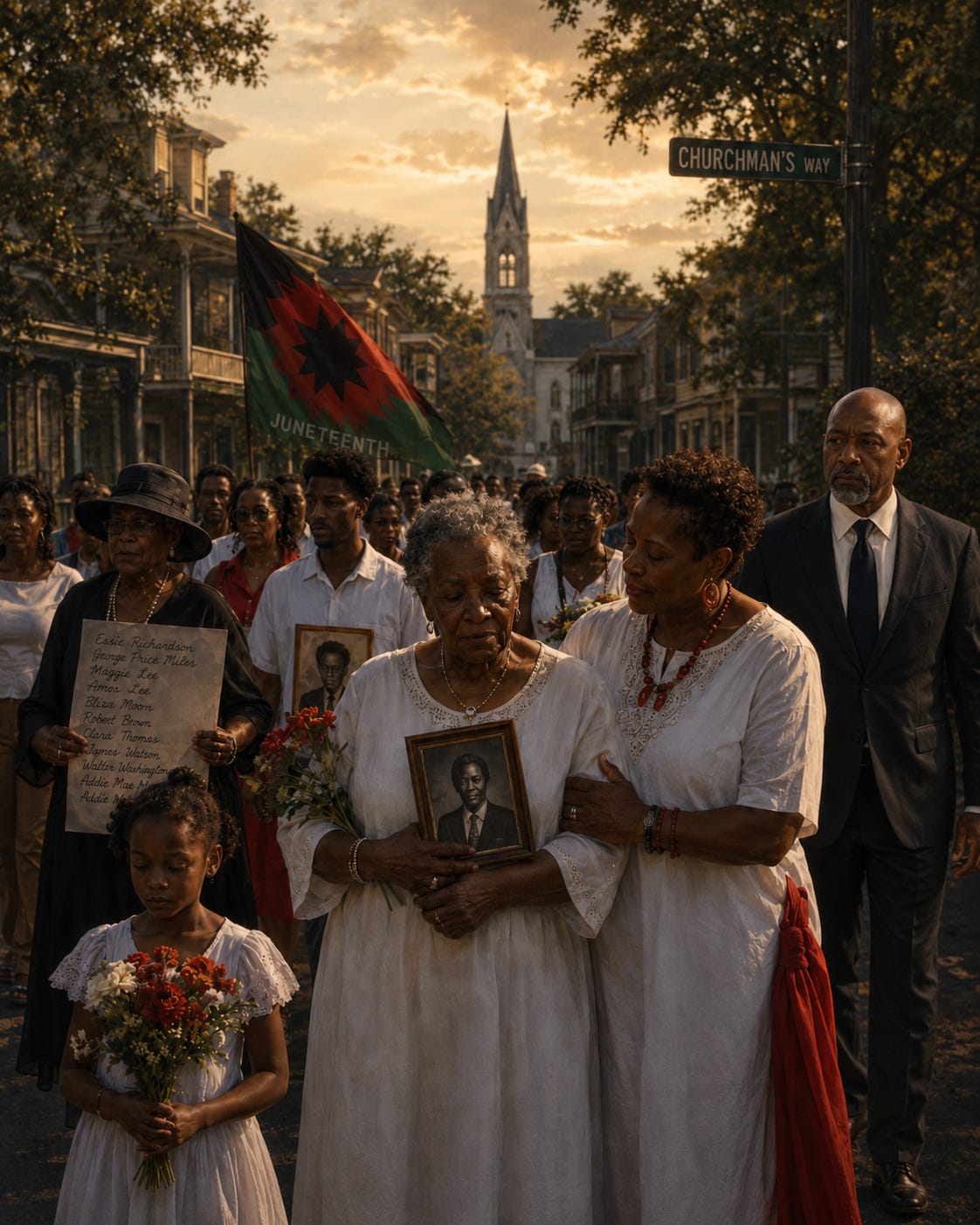
At four o’clock, the city’s eyes were on Old Avery, near Churchman’s Way, down the block from New Season Baptist, for the Ancestor’s Walk. People lined up in white, black, red, whatever was clean. Some carried flowers, some carried photos, names on index cards, and a few had instruments. Others carried nothing because their people had left the world before they had anything to hand down other than love.
The walk was for Isaiah Avery.
The walk was for Walter Holloway.
For Reverend Saunders. Both of them.
And Clara Whitfield. And Henry Caldwell. And Amos Barksdale.
And Such.
And the women who waited on people hand and foot, while their kids had to fend for themselves.
It was for the men who built homes they could never own.
It was for everyone who had never heard freedom call their name.
Loretta Johnson stood near the front, holding a small photograph of her grandmother. Zora Holloway steadied the elder’s elbow as she moved with the procession. Her great uncle was a few people away from them, no convertible, no security team. Just him and his brother, Earl, their father’s name in their hearts, the soul of Avery Heights surrounding them.
The walk crept through Old Avery past porches that held generations of tired. Past windows where mothers watched. Past children who were too young to understand why their parents told them to be quiet. When they turned toward Griffin Row, where new windows and old bones were neighbors, transplants watched in awe while Avery Heights lifer Lenny Booker covered his heart with a photo of his mother and grandmother.
“Isaiah Avery walked here. Free. But freedom didn’t guarantee his safety. Freedom didn’t mean people wanted him here. Freedom didn’t stop the world from hunting you. He arrived at land everyone said was bad and laid the foundation for a place that developers now see as a gold mine.
No one clapped. There were raised fists, a few snaps, and someone said “Ase.”
Miles Holloway bowed his head. He wasn’t the mayor at that moment. He was a son of the city.
As the evening drew closer, West Avery took its turn celebrating the holiday. The West Avery Consortium threw a block party on Freeman Ave, right past Maggie’s Table and the dividing line with North Hill. There was a resource fair, food trucks, a stage, and their own banner that read:
WEST AVERY ASCENDS: A JUNETEENTH CELEBRATION OF RESILIENCE AND COMMUNITY
“Ascend? We been down?”
Ronald Boone was struggling to get up from his lawn chair.
“Them kids always talking to us like they here to save us from something.”
Pat Carson, who’d lived in West Avery all sixty of her years, knew the members of the Consortium since they were bumps in their mother’s bellies, and was less than impressed with their efforts.
In fact, people bypassed the food trucks and stacked their plates with food from the grills set up in the yards on side streets. They walked around the voter registration table in front of Keisha’s mother’s house. The DJ played two songs, and somebody’s uncle yelled for him to play something else.
Ameerah Bell stood near the stage, wearing a brave face, but obviously concerned with the low turnout and disinterest.
“Y’all threw a block party but forgot to talk to the block.”
Link Doggett was sitting in a folding chair. Out of sight from practically everyone but Ameerah.
“We did all of this for the community.”
“Then let the community happen. Stop trying to force your version on it.”
Link scanned the scene with his finger. The people dancing to “The Wobble”, teenagers taking videos, old heads playing dominoes, the women arguing about who made the best potato salad, and Ronnie Boone falling asleep with a red cup teetering on spilling in his lap.
The DJ mixed in another song, and someone screamed. The party was really starting now. The laughter almost drowned out the music; somebody told a child to stop running before they fall, and the potato salad argument stopped for a song or two. The party for the people who had been displaced, overlooked, surveyed, and still didn’t need saving, but still found joy.
When Mayor Holloway arrived, everyone cut their eyes to see how he handled the moment. Gone were the suit and tie, replaced by khaki pants and a navy polo with “Avery Heights” stitched on the chest. He’d given speeches all over town — at the golf course, at the parade, after the Ancestor’s Walk, and even went live on Facebook for the official Juneteenth proclamation- but he was well aware of where he stood when Ameerah offered him the microphone.
“I’m going to keep this short, because I smell Alonzo Harris’ ribs from here. This morning, I was at Sable Run, and I thought about my father and how he hated the idea of a golf course running through parts of Avery Heights.”
He paused and looked out at the faces that were trained on him.
“He’s largely responsible for what this city became, but Isaiah Avery gave this place more than streets, houses, offices, and whatever else. He gave it a version of freedom that my father, anyone with him at the beginning, or me, in my time as mayor, could ever dream of. That freedom is the true meaning of Juneteenth — not just signed on a paper, but freedom made real.”
Miles looked at a row of folks he’d known since grade school.
“In trying to move Avery Heights forward, I am afraid that I may have failed my father. Failed Isaiah Avery’s freedom. I have failed you. The freedom the citizens of this city deserve doesn’t price them out or have celebrations on land your grandmother was forced to move away from, and no one has the decency to say her name.”
He stepped back to wipe the sweat on his forehead.
“The stories we tell, the names we can’t forget, along with the homes you all work to protect, and the businesses you’re building, are the real Juneteenth work. It’s an inheritance that lasts longer than a day. It’s what you’ll pass on to others, without thinking someone is going to reach into your pocket and take it.”
He took a deep breath.
“I’m going to get out of the way, because those ribs smell too good, but before I go. Today, we honor our ancestors. Those who walked the road ahead of us. Some who held our hands as we walked with them. And those who left far too soon. Happy Freedom Day, Avery Heights! May we walk worthy. May we walk right. May we leave this city freer than we found it. This seems like as good a time as any to announce my retirement as mayor at the end of my term.”
You could’ve heard a pin drop before there was a round of thunderous applause.
Some people have only known Avery Heights with Miles Holloway as mayor. Others remember the city before he took office, and though they may not agree with the development happening around the city, they remember the years the city didn’t have a grocery store, when the state controlled the school district, and the crime that kept people inside their homes. When too many blocks felt abandoned.
His shoes were too big to fill, but there would be plenty of people trying to do just that. Council members, pastors, members of the West Avery Consortium, school board members, brothers from the barbershop, and one of those rich, North Hill types. The city would grieve after his last day in office, but tonight, it will party.
The DJ played Frankie Beverly; Ameerah helped move the voter registration table; Khalil Cole took off his Consortium shirt, folded it under his arm, and stood in line for a burger.
Miles Holloway sat on the bumper of a car and ate ribs from a paper plate.
Link studied him from across the street. There was something about seeing a man who would become history lick barbecue sauce from his fingers.
A little boy walked up to him with confusion on his face.
“What’s the Ancestor’s Walk for?”
Link looked toward Old Avery.
“It’s so the dead know we haven’t forgotten them.”
He watched the boy think about what he said.
“The dead can hear us?”
That made Link smile a little.
“They have their ways of hearing. And their ways of talking back to us.”
The boy accepted this truth and ran off.
The evening wind lifted the banner above them as the night stretched itself over Avery Heights. Old Avery held onto its memory. Griffin Row grappled with its becoming. SouthCut tried to remember what it was told to forget. North Hill closed its gates. West Avery opened its arms to the possibilities.
Nobody got free all at once.
Some never got free at all.
But that day in Avery Heights, the living called the names of the dead into the air, people danced in the street, children learned about freedom, old folks chewed their meat slowly while watching everything, and for a few hours, freedom didn’t feel like a lie.