
Watch Night

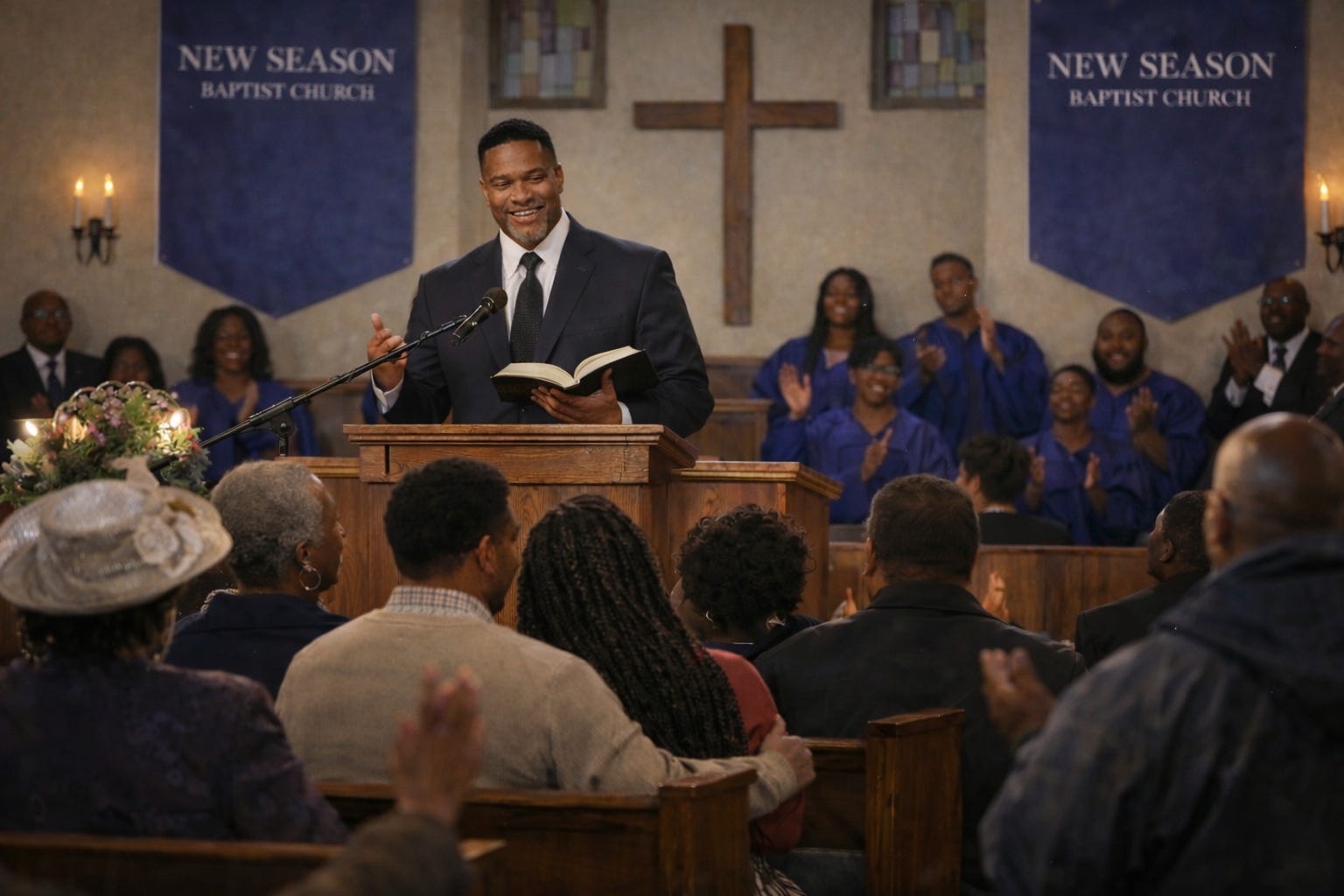
“New Season.”
Pastor Ronald Ellis smiled from the pulpit. He was wearing a new suit—sharp but toned down by the dark tie. He wasn’t a preacher invested in theatrics, not in his delivery or his style, but he was invested in his congregation. He didn’t scan the crowd assembled for Watch Night like a security camera. Instead, he looked like he was greeting everyone whose eyes met his.
“Pastor.”
The room called back.
Watch Night brought in just as many people as Easter Sunday. The pews weren’t packed simply to end the year or out of habit. They were filled because of memory. Watch Night began on December 31, 1862, Freedom’s Eve, when the enslaved gathered in churches, barns, and hush harbors, waiting for the Emancipation Proclamation to take effect. No one knew what the sun would bring, so they spent the night praying, singing, knowing; they wanted to cross over together.
In Avery Heights, you went to Watch Night because your grandparents taught you that you owed God a thank-you for carrying you through one year and a prayer that He would do it again in the coming year. You went to Watch Night to remember those who didn’t make it. Watch Night is for witnessing.
For saying we will not cross alone.
Folks who hadn’t been inside a church for a month of Sundays showed up on Watch Night. Husbands who gave their wives money for collection were seated next to them. Daughters who moved away for a man they can’t remember found their way back. Politicians weren’t begging for votes. Police officers fellowshipped with people they usually watched with both eyes, and the church mothers wore their special crowns.
“Tonight, I’m going to preach from the Book of Isaiah. Chapter 43, verse 19. I know most of you don’t have your Bibles, so someone shout, ‘Talk to me, Pastor’, when you’re ready.”
“Talk to me, Pastor.”
There was a chorus of altos, sopranos, tenors, and even a bass or two.
“I’m reading from the King James Version, because that’s the version my grandmother read to me.”
“Say that, Pastor!”
He didn’t recognize the voice, but he knew the feeling.
Many people were still turning pages, not because they didn’t trust him, but because church folks like to read it for themselves.
“The scripture reads, ‘Behold, I will do a new thing; now it shall spring forth; shall ye not know it? I will even make a way in the wilderness, and rivers in the desert.”
He stopped.
The words worked their way through the pews and settled at the doors of the sanctuary.
“A new thing. A way in the wilderness. Rivers in the desert.”
He leaned into the microphone, repeating the extracted fragments of the verse.
The room seemingly leaned toward him.
“How many of us can be honest? Some of us have been in the wilderness for so long that we’ve got flat screen TVs and air fryers with us. Get our mail delivered there. Got a welcome mat for our struggles. Made ourselves a home.”
There was a soft laugh passing through the sanctuary. The kind that accompanied truth.
“How many of us have gotten so cozy with our dry seasons that we don’t pray for rain or rivers anymore. We only ask God that we outlive the thirst.”
That got the attention of The Amen Corner.
Somewhere near the middle of the church, Ari sat with her legs crossed at the ankle, doing her best not to wrinkle her dress. Her group chat was buzzing steadily—she was meeting her girls at HUE, but her grandmother would kill her if she didn’t at least show her face at Watch Night. Even if she showed up in a dress that would make a few deacons look twice if she unbuttoned her coat.
Her phone buzzed again. She glanced at it, then tucked it into her clutch; she refused to have her grandmother, watching the livestream at home, see her on the phone.
“Baby, before you do anything else tonight, you find yourself in a church to thank your maker.”
Mama Millie, as she was known to her loved ones, rarely left the house anymore. She was 88 and recovering from a stroke that almost didn’t allow her to see her way through 2025. However, Ari felt her voice on the phone earlier sounded stronger than it had in years.
“I know, Mama. I’m getting myself together now.”
“Your cousin Kia is coming over here to set her computer up on my TV, so don’t disappoint me.”
That was church code. Family code. A warning.
Ari sat there counting down to 11:00 p.m. in her head. She had the night planned out. She would go to church from 10 – 11, be in the VIP at HUE by 11:15, and follow the night wherever it led her from there.
She nearly looked back into the camera so Mama Millie could count her among the living.
“God said, ‘Behold.’”
Pastor Ellis raised his hand.
“Y’all know what that means? It means stop. Looka here. Pay attention. Not a maybe or a might. It’s behold. God is saying I’m trying to show you something over here, but your eyes are trained on what’s got you lost.”
Ari sat up a bit straighter.
Two pews up, Miss Loretta sat in her usual pew, hands folded neatly in her lap, crown slowly tilted towards West Avery. She’d watched Pastor Ellis grow up in his grandmother’s lap and sometimes called him Ronnie when no one else was around.
Three weeks ago, she sat in an office with a doctor who held her hand as he gave her facts and timelines and stages and treatments that sounded like books of the Bible. She nodded to each sentence, asked questions she didn’t want answers to: What are the side effects? Am I dying? How much will this cost?
Then she walked out to the car of the New Season Care Team assigned to drive her to the appointment and asked her to drive straight to the church. She sat in the sanctuary. She didn’t cry. Or pray out loud. She just stared at the choir stand until she heard “Amazing Grace.”
She hasn’t told anyone about that visit. Not because she’s scared or ashamed, but because she didn’t want anyone’s pity. Tonight, she was the first to arrive, watching the stained glass until the voices of joy filled the sanctuary. In her heart, she was negotiating with God, asking for time served for her good deeds as a faithful Christian.
“Now it shall spring forth, shall ye not know it? Other translations say, ‘Do you not perceive it?’”
Pastor Ellis stepped from behind the pulpit.
“Perceive means it’s already happening. God doesn’t wait for a calendar. He doesn’t care if it’s January 1st or December 32nd, that new thing is happening before you can call the other thing old.”
A bead of sweat trickled from his forehead.
“We pray for peace, then don’t recognize when God sends us boundaries. You're looking for a feeling and, here God has made a decision over your life.”
“Yes, Lord!”
Someone in the back cried out.
In the pew across from her, Khalil and Nia sat close, but not quite touching. They’d been spending a lot of time together since winter break started, but danced around the elephant standing between them. Khalil confessed his feelings to an already knowing Nia before he headed West for school. She gave him a card he read while waiting to board, sharing how she felt.
They kept in touch throughout the semester despite the three-hour time difference. Texting led to FaceTime calls and voice memos when they couldn’t sleep. There were quick phone calls between classes. She’d been home for a week when he returned from California, bringing a snowstorm in his luggage. Still, they walked to the park that day to catch up on grades, compare notes on roommates, and just be close to one another.
And now Khalil asked her to come to Watch Night with him and his mother.
“The Arts Center is having an open mic tonight.”
Khalil laid his elbow on the back of the pew as cool as possible.
“You trying to have me outside tonight.”
“I’m saying, we’re already out. We can head over there before it gets too crazy.”
“You know my daddy gonna be having his own watch night at the front door.”
Khalil laughed too loudly, and his mother gave him a sharp look, which made Nia swallow a laugh.
Khalil brought his arm down and rested his hand on the edge of the pew until their pinkies touched. It was barely contact, but Nia didn’t pull her hand away.
“Some of you are carrying, 2025, 2020, 2008, 1987, and even before I was born into 2026, because you think you can’t leave anybody behind.”
Pastor Ellis’ voice rose.
“I want those of you to hear me: This new thing is going to require you to stop carrying what God never places on your back.”
That line landed in the sliver of space between Nia and Khalil’s pinkies.
It landed in Ari’s group chat that never stopped buzzing in her purse.
It landed in Miss Loretta’s soul.
It found the man standing in the back, close to the doors on the left, one foot ready to leave, the other planted firmly.
His name was Leon Jefferson, but it had been two lifetimes since that name was spoken in Avery Heights. His Christian name was replaced by “That Jefferson Boy”, “Nothing but Trouble”, “The One Who Went Away”, and was not spoken in the house that birthed him.
No one can ever point to a thing Leon did to earn those names, but the stories of things he was thought to have done were legendary, including stealing from the very church he stood in.
He got into town ten minutes before the service began and figured this was as good a place as any to get out of the cold until he could figure out his next move. He hoped to see someone he used to run with, or at least a family member who didn’t get nauseous when saying his name.
But the sermon kept calling his name.
“God makes a way in the wilderness. Not you. Not how smart you are or how much hustle you have. God. So many of us been out here figuring it out on our own so long that we don’t realize when a way has been made for us.”
Pastor Ellis dabbed at his forehead.
Leon stared at him as if he were seeing a ghost. His mother used to wrangle him and his siblings to church every Sunday, back when Reverend Saunders was the preacher. He never paid much attention, and his thighs wore the bruises of pinches to prove it. He barely had hair on his top lip when he decided church wasn’t the place for someone like him and stopped waking up when she entered his room on Sunday morning.
Now, his hands were clenched in the pocket of his hoodie, as if he needed to hold himself together.
“Sometimes the new thing is that you’re still here.”
Pastor Ellis laughed.
“Sometimes, that new thing is that you’re still able to breathe after a year or years tried to kill you. Do you not perceive it?”
Someone to his right stood, raised their arms, and cried out to Jesus.
Leon’s other foot was ready to leave.
Pastor Ellis lowered his voice.
This didn’t feel like a good idea anymore. Didn’t feel right. He was emotional. He hated being emotional. Emotion meant you were vulnerable. And only children and victims were vulnerable in Leon’s world.
Pastor Ellis talked about the wilderness as if it were Leon’s address.
Suddenly, he pointed to the music minister, who stood up, then pointed to a young man sitting to the far left of the choir stand. The young man walked to the microphone with a confident smile that said he was about to tear the church down, from pillar to pew.
“He’s been so good to me…”
The entire sanctuary held its breath. A few hands shot towards the sky; more eyes went wide. A few people looked around, waiting for someone to blow a whistle and stop what was going on.
Everybody in Avery Heights knew this song belonged to a different voice. In New Season, My. Zion, Greater New Hope, and any of the other 32 churches in the city, “He’s Been So Good to Me” was Trevon Samuels’ song.
His voice was the jewel of the city at one time, and it made its home at New Season. It was kind of the voice that made the church mothers shout and the deacons’ eyes sweat. He only sang “He’s Been So Good to Me” three times a year: Easter, Reverend Saunders’ pastoral anniversary, and Watch Night, but when he did, it was said that it felt like your ancestors were sitting next to you in the pew. Old folks said it, so it must have been true.
The song was his tithe to the Lord, then life took a turn, and he was heading to North Carolina before anyone could change his mind. Some people say he went to Charlotte to record a gospel album; some say he went to care for his ailing father; some whispered about a son; others claimed he was on that “stuff”. Whatever the case, before he left, Reverend Saunders said the song would never be sung again in New Hope unless Trevon was behind the mic.
That was six years before Reverend Saunders died and eight Watch Nights since Pastor Ellis took his place in the pulpit after his mentor suffered a massive heart attack. No one really knows if he was promised the song was retired, but Avery Heights loves folklore and rules that no one took the time to write, but still get followed.
“He’s been so good...so good...”
The young soloist didn’t know the rules.
Suddenly, heads began to turn to a pew midway up the aisle on the right. People whispered; the boldest among them pointed. Trevon Samuels has what could be a smile or a grimace on his face. He was bundled up in a coat buttoned to the edge of a beard he didn’t have when he left town fourteen years ago.
He looked older, wearied by life, like a man who came home to reclaim something he couldn’t name. His cousin begged him to go to Watch Night, just happy to have her cousin home for the holidays.
He stared straight ahead, not at the soloist, but at the choir. There was a slight tightening of his jaw, and his shoulders hung close to his ears. The song carried through the sanctuary, touching those who didn’t know the history and passing over those who lived with Trevon’s version in their heads.
Trevon stood. It wasn’t sudden. More like, inevitable.
The room hushed itself.
The young singer nearly missed a lyric as he followed everyone’s eyes.
Trevon excused himself and entered the center aisle.
No microphone. No warmup.
Neither was needed.
“He’s been so good...”
The sound came from his chest, warm and layered, like butter being poured over cornbread.
Pastor Ellis sat in his seat.
The young man grabbed the microphone and leaned into a run. It was obvious that he was an anointed singer, but he may have been boxing out of his weight class and would be the last to find out.
Trevon reached into his gut to find a note that ended in his upper register.
“Sing, Trevon!”
Miss Loretta was on her feet.
All eyes shifted back to the choir stand.
The young man’s falsetto floated so smoothly that Trevon had to smile.
“Sing, Baby!”
It could have been the singer’s mother.
The choir stood and provided backing vocals for what was less of a sing-off and more of a generational debate.
“Oh my God.”
Ari stood; her clutch fell to the floor. She wasn’t thinking about HUE or her carefully laid plans for the night. She had goosebumps on her arms and tears in her eyes.
Khalil and Nia looked at one another, a million words they couldn’t translate between them as their hands found each other.
Miss Loretta closed her eyes and lifted her hands. Tears streamed down her cheeks. She didn’t wipe them. She let the song say what she’s been carrying for three weeks.
The organist dropped the music, and the singer looked at Trevon.
“He. Kept. My. Mind.”
The room erupted.
This was the part those who knew were waiting for.
The young soloist responded, holding each word like it was precious.
This wasn’t competition. It was communion.
Pastor Ellis sat back in his seat, smiled, and lifted two hands to Heaven. He didn’t interrupt. Didn’t attempt to wrestle the order of the events back from the singers. He knew that sometimes the music did more work than the sermon.
People stood. They sang. They cried. They praised out loud. Others sat in their seats and did the same thing. There was a spirit moving through New Season, and no one in the building was immune to it. Even Leon.
When the last “to me” hit in unison, the room was washed with glory. The clock didn’t matter. Pastor Ellis returned to the pulpit and closed his Bible. He adjusted the microphone but didn’t speak for two minutes.
“A new thing is happening at New Season. And sometimes it is mixed with a not-so-new thing.”
He looked toward Trevon, still standing in the aisle, face lathered with sweat, his coat on the floor behind him. There was pride in his shoulders, but wounds in his knees. The soloist was making his way to him, arms opened wide.
Pastor Ellis smiled when they hugged.
“Home is always somewhere you can come back to. Some of you think you can’t come back because you left. Because something happened. Because life ain’t going the way you planned. Because you made choices that turned into bad decisions. Because too much time has passed. But God says He will do a new thing. He doesn’t say He will do it only for people with no strikes.”
The Amen Corner told the pastor he was right.
“Trevon, we know that’s your song, but young Jace needed to borrow it tonight, because sometimes the new thing is finally making a stand and decided you’re no longer who you used to be.”
Leon felt like Pastor Ellis was staring at him while he talked to the man standing in the aisle.
“If you want prayer. Come.”
The altar call nearly made itself.
Leon’s mind was still processing the words when his feet started moving.
He stepped forward, behind two other men walking the same walk. There were a few double takes; whispers failed in the throats of the gossips. Leon made his way to the front and went to his knees. Right next to Trevon.
He didn’t know what he was doing, but didn’t question it.
“Say his name.”
He felt a hand on his shoulder.
He didn’t need to look up to know it was Pastor Ellis’ voice whispering to him. He trembled. He didn’t know if it was fear or something else working through him. He felt like a child kneeling before his father.
“Jesus.”
It came out as a scream.
The room rejoiced.
Everyone in the church had someone they loved who needed a new thing. For many of them, that somebody was them.
Ari fussed at herself for ruining her makeup. Miss Loretta watched Leon at the altar and allowed herself to find space in the corner nearest her seat. She, too, was standing in the need of prayer.
“You okay?”
Khalil mouthed the words to Nia, who held on to his hand like she couldn’t live without it.
She wiped tears from her eyes and nodded.
“I miss you.”
She smiled as tears avoided her hands.
Khalil froze. He didn’t know what to say. Didn’t know what to do. His first instinct was to kiss her, but he chose to pull her into a hug instead.
Pastor Ellis prayed over Leon, quietly, words between the two men and God. When he was finished, he helped Leon up and pulled him into a brief hug. Once released, Leon pawed at his eyes with the back of his hand, like he was embarrassed to be seen crying.
New things take time.
“We’re about to cross over. But before that clock strikes midnight, I want you to know there’s still time to make room in your soul for the new thing. Don’t carry it any longer. God is asking you to surrender it. Right here. Right now.”
He paused, then motioned for an army of ushers to make their way forward with the watch-night candles.
Pastor Ellis smiled as the lights dimmed and the small lights came to life, one by one, passed through the maze of people near the altar, crowding the aisles, and those still in the pews.
This was their inheritance.
“Fire is holy when you respect it.”
Ari held her candle and thought about her grandmother’s prayer altar in her living room, where she lit candles to mark the birthdays of family members gone to Glory... and other places.
Miss Loretta’s candle was steadier than her heart.
Khalil lit Nia’s candle with the flame given to him by his mother.
Leon looked at his candle like it was proof of life.
Pastor Ellis stepped back into the pulpit.
“Ten.”
One of the deacons started the countdown.
The room joined in.
“Nine. Eight. Seven. Six.”
The choir was humming a hymn.
“Five.”
Ari’s phone buzzed at her feet.
“Four. Three.”
Pastor Ellis closed his eyes.
“Two. One.”
“Happy New Year!”
The sanctuary erupted in a sweet release.
The choir started “Oh, Happy Day.”
Pastor Ellis walked through the crowd, hugging people, telling them they made it. They survived. He spoke closely and quietly to a man crying uncontrollably.
“Perceive it.”
The man fell into the arms of two deacons.
People hugged. Sang with the choir. Some covered their flames and continued to pray.
“Are you okay, Mother?”
Ari was surprised at her grandmother’s tongue in her mouth.
She found herself at the front without remembering the steps she had taken. Miss Loretta was next to her, eyes filled with tears. She managed a smile. The version she’s rehearsed since the diagnosis.
“I’m trusting God, baby.”
A genuine smile followed.
Khalil and Nia stepped out into the cold night together. The wind pushed them together.
“Two weeks left.”
Nia looked up into Khalil’s face.
“That means we can’t waste any more time.”
“I don’t want to.”
Nia smiled. Khalil exhaled, realizing he’d been holding his breath since August.
“If y’all don’t come on. It’s too cold for y’all to be making googly eyes at one another.”
Khalil’s mother appeared, keys in her hand. She lifted her scarf around her face to hide a smile.
Leon found himself in a corner, tugging at the sleeves of his coat.
“I’m proud of you, brother.”
Deacon Hardaway appeared with his hand extended.
“I don’t know if I...”
The deacon held the hand that Leon shook up for him to see.
“You ain’t gotta figure it out tonight. You took a step tonight. Take another one tomorrow. Two more on Saturday. Then find yourself in someone’s church on Sunday.”
Leon nodded as if he had been given access to a world he had forgotten existed.
Trevon, still sweating, still overwhelmed by the spirit, greeted choir members as they walked through the sanctuary, singing. He told those he knew that he missed them and introduced himself to those who were too young to have heard him sing before tonight.
“I’m sorry. I didn’t know.”
Jace found himself next to Trevon again.
“No apology is necessary. You gave me the reminder I needed.”
“Of what?”
Trevon looked around the sanctuary, at the people hugging, Pastor Ellis talking to them, how the year had changed, and no one had fallen apart.
“Of what was left behind and what I can still return to when I need it.”
Jace hugged him again.
Pastor Ellis found himself near the church doors.
He took a deep breath and took it all in. If someone asks him tomorrow what his sermon was about, he will say it was about recognizing God’s voice amid a mess. About old songs and new voices. About perceiving. He would say it was about a new thing starting, like it always did; small, inside, then bursting through like the fireworks that lit the Avery Heights sky.
Let the church say Amen 🙏🏾