
Writing Avery Heights
Part I: Place

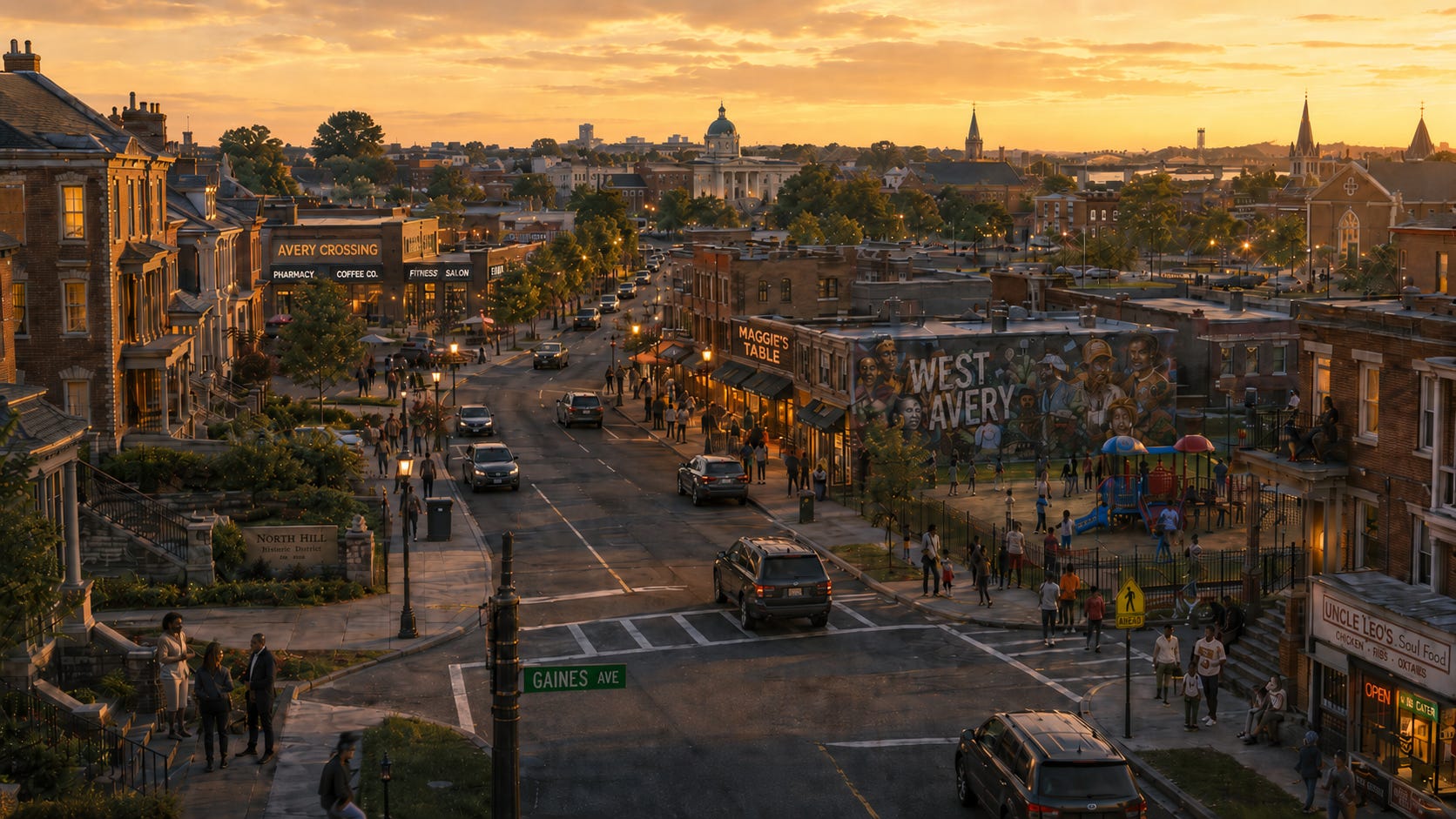
I created Avery Heights because I did not think I wrote setting or place well.
I’ve always known how to find my way into people. I could hear their voices, tell of their grief, secrets, love, and even shame. I could write about a man spiraling because of regret or a woman running through her responsibilities like it’s a grocery list. I could tell entire histories through dialogue or silence, but where were these people in the world?
My stories took place in rooms or houses, but not neighborhoods. The characters didn’t have streets that knew their names or sidewalks that held memories of knee scrapes, first kisses, or a first heartbreak. They met in restaurants without names and churches without mothers in the front pews.
I needed my readers to feel where these people came from as much as they felt who they were. So, I decided I would build a place from the ground up in an attempt to capture the texture of the would I live in. The world my characters live in.
I guess I could’ve started with a city I’ve lived in, or grew up in, where readers might be able to fill in blanks or remember details of what things were, but that didn’t move me. I needed to draw the map myself. I needed a city that made me think about blocks, neighborhood landmarks, class structures, churches, history, parks, bars, beauty salons and barbershops, funeral homes, schools, the city politics, places to grab a bite to eat, and the side streets where life really happens.
It started with a story I was writing for my Black Men Writing Fiction group. I knew how I wanted to frame the story of the brothers returning to their childhood home after their mother’s death. I knew I wanted that house to come alive, but I needed that house to live in a neighborhood and city that knew who Evelyn Richardson’s sons were.
Somewhere in the first paragraph of the story, I wrote that the sun was setting over Avery Heights, and it stuck. What started as a craft exercise or a way to see the setting more clearly had a name, and I began to build it from there. One Saturday in Weekend Words, I wrote a story taking place on the Sable River Bridge, which became a thoroughfare in and out of Avery Heights.
Avery Heights started as a craft exercise, a way to practice, and a way to deepen my work down the road. But a funny thing happened as I started building the city; it began building itself.
The story ideas came to me quickly in the form of questions. What does Palmetto Street look like on a hot summer morning? Who’s the pastor of New Season Baptist Church? What happens at a bar on Tuesdays? What does city hall look like when a protest is happening outside? What does the mayor really feel after forty years of public service? How do houses hold memories after the people who made them home are long gone?
Those questions turned into stories, and those stories birthed Old Avery, SouthCut, West Avery, North Hill, the Sable River, The Magnolia Room, The Ebony Room, and the Big Yellow House. The places I was creating for these characters and stories felt less made up and more like memory. Avery Heights became a city where your family’s name carried some weight, or shame, a place where roots run deep.
The lesson I sought wasn’t the lesson I needed. I started out with the intention of creating place as setting, but that was wrong. Place is a character. Memory. Witness.
A place reveals who has power and exposes who is hiding behind masks. It shows the true meaning of community: how it mourns and what it refuses to let die. Place shapes how people operate in the world, how they love or leave, how they dread returning, and how high they hold their head in a room where everyone knows their grandmother’s maiden name.
Shaping Avery Heights took me further than merely describing how the sun entered the blinds at 3:15 P.M.; it used description to reveal life. For instance, a porch is just a porch, but Earl Holloway sitting on a porch his father built seventy years ago reveals the weight of carrying a legacy. Or the Magnolia Room being more than a place to eat, but a place where class, faith, love, and performance intersect over brunch.
Avery Heights gave me a home to write about Black life with authenticity and texture, while giving my characters a place to belong, to be judged, haunted by decisions, somewhere to come home to, or a place to start again where no one knows your name.
Somewhere along the way, this fictional city in New Jersey became home. Home to the Holloways and Loretta Johnson, and Such, and Monroe, but you’ll learn more about them later.
I created Avery Heights to become a better writer of place, but I’ve stayed in Avery Heights because there were stories that needed to be told.
I love this! Place is so foundational. And you chose a good name :)